
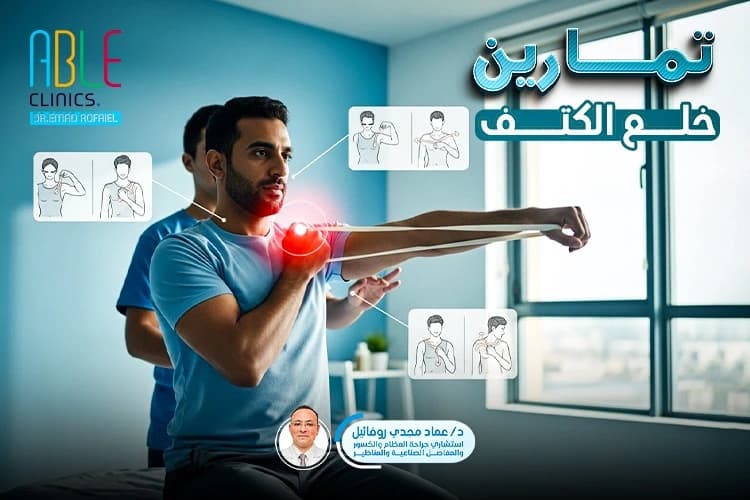
Following a shoulder dislocation, treatment is not limited to merely resetting the joint; the recovery journey extends to include an intensive program of exercises aimed at restoring strength, flexibility, and stability.
Rehabilitation exercises (shoulder dislocation exercises) are the most crucial part of this process, as they help prevent recurrence of the injury and ensure a safe return to daily and athletic activities.
Important Note: Before starting any exercise, you must consult a doctor or a physical therapist. They are the only ones capable of determining the appropriate stage for you and the type of exercises you should perform.
Early Stage Shoulder Dislocation Exercises: Restoring Gentle Movement
After the shoulder is reset and immobilized with a brace or sling, the early phase of recovery begins. During this period, the main goal of exercises is to maintain the remaining range of motion and prevent joint stiffness, without putting any stress on the injured tissues.
Critical Warning: These exercises must be performed slowly and with great caution, and only after approval from your doctor or physical therapist. Stop immediately if you feel any sharp pain.
1. Pendulum Exercise
This is the first and most fundamental exercise in the post-injury phase, relying on gravity to move the joint gently.
-
Bend slightly at the waist, resting your uninjured hand on a table or chair for stability.
-
Allow your injured arm to hang freely and relaxed.
-
Start moving your body slowly back and forth, causing your arm to swing in small circular movements like a pendulum.
-
Gradually increase the size of the circles, then reverse the direction of the swing. Continue the exercise for one to two minutes.
2. Elbow Flexion and Extension Exercises
This exercise does not move the shoulder, but it is essential for maintaining arm mobility while the shoulder is immobilized.
-
Sit or stand in a comfortable position.
-
Slowly bend your elbow, bringing your hand toward your shoulder, then slowly straighten (extend) it again.
-
Ensure that you are not moving your shoulder during the exercise. Repeat the movement 10 to 15 times.
3. Isometric Contraction Exercises
These exercises strengthen the muscles without moving the joint, making them very safe in the early stages.
-
To strengthen internal rotators: Place your injured hand on your stomach. Gently press your elbow against the side of your body for 5-10 seconds. Relax and repeat.
-
To strengthen external rotators: Stand with your injured hand against a wall. Gently press your elbow into the wall for 5-10 seconds. Relax and repeat.
4. Passive Internal and External Rotation Exercise
This exercise helps to slowly restore some of the shoulder's rotational movement.
-
Lie on your back and hold a light stick (like a broom handle) with both hands.
-
Using your uninjured hand, slowly push the stick toward the injured side, causing your injured arm to rotate inward.
-
Then slowly pull the stick in the other direction.
-
Perform this movement slowly and carefully, stopping at any point you feel pain.
Remember that this phase requires patience and discipline. Commitment to light and regular exercises is the foundation for safely and effectively progressing to the next stages of recovery.
Intermediate Stage Shoulder Dislocation Exercises: Building Strength
I. Stretching Exercises (For Improving Flexibility)
These exercises aim to gently increase the joint’s range of motion and alleviate stiffness, acting as a bridge between passive movement and strengthening exercises.
Wall Shoulder Stretch:
-
Stand an arm's length from a wall, and place your injured hand on the wall at shoulder height.
-
Slowly move your body toward the wall, keeping your hand fixed, until you feel a gentle stretch in the front of your shoulder.
-
Hold this position for 20-30 seconds. Repeat 3-4 times.
Cane/Stick Stretch:
-
Hold a light stick (like a broom handle) with both hands, placing it behind your back.
-
Use your uninjured hand to slowly push the stick upward, raising your injured arm.
-
Hold the position for 15-20 seconds, then slowly return. Repeat 3-4 times.
II. Strengthening Exercises (For Building Muscle Power)
These exercises are the core of the intermediate stage, helping to restore joint stability and prevent recurrent dislocation.
Resistance Band Internal and External Rotation:
-
External Rotation: Tie a light resistance band to a door or a stable post. Hold the other end with your injured hand, and pull the band outward while keeping your elbow bent at a 90-degree angle. Repeat 10-15 times.
-
Internal Rotation: Face the band and slowly pull it towards your body. Repeat 10-15 times.
Scapular Squeeze ("Wring" the Shoulder Blade):
-
Sit or stand up straight.
-
Pull your shoulder blades back toward each other, as if trying to squeeze something between them.
-
Hold this position for 5 seconds, then relax. Repeat 10 times.
Partial Wall Push-up:
-
Stand in front of a wall, place your hands on the wall shoulder-width apart.
-
Slowly lean toward the wall, then slowly push your body away from it, keeping your back straight.
-
This exercise strengthens the muscles responsible for stabilizing the shoulder joint.
Advanced Exercises for Return to Sport After Shoulder Dislocation
Once the shoulder has regained its full range of motion and core strength in the intermediate recovery phase, the goal becomes preparing the joint for a return to athletic activities. Advanced exercises focus on building functional strength, increasing endurance, and improving muscular control necessary for safely performing complex sports movements.
Important Warning: Before starting these exercises, you must obtain clearance from your doctor or physical therapist. Rushing this stage can lead to re-injury.
1. Functional Strength Exercises
These exercises are used to strengthen the muscles that stabilize the shoulder joint during movement.
Push-ups:
-
Start with wall push-ups.
-
Once comfortable, progress to kneeling on the floor, and then gradually to a full push-up position.
-
This exercise strengthens the shoulder, chest, and arm muscles in a way similar to movements used in sports.
Pulling Exercises (Rows):
-
Use a medium-to-heavy resistance band or a cable machine at the gym.
-
Sit or stand straight and pull the band or cable towards your body, focusing on squeezing your shoulder blades together.
-
This exercise is essential for strengthening the back shoulder muscles and upper back, which enhances stability.
Overhead Press:
-
Start with very light weights (or just a stick/cane). Sit or stand with a straight back.
-
Slowly push the weight overhead, keeping your elbows close to your body as much as possible.
-
This exercise mimics throwing or pushing movements above the head common in many sports.
2. Explosive Strength Exercises
These exercises aim to build the speed and power necessary for athletic performance.
Medicine Ball Throw:
-
Start with a light medicine ball.
-
Hold the ball with both hands and push it forward forcefully from chest level, as if you were throwing a ball in a sport.
-
This exercise helps train the muscles to produce force quickly.
Plyometric Push-up (Advanced):
-
This is for a very advanced stage.
-
From a push-up position, forcefully push your body up so your hands briefly leave the floor.
-
This exercise must be performed with extreme caution and after consultation with a specialist.
3. Sport-Specific Movements
At this stage, you can begin to mimic movements specific to your sport, starting slowly and gradually increasing the intensity.
-
Throwing Simulation: If you play basketball or baseball, practice throwing a ball slowly without using full force initially. Focus on proper and controlled movement, then gradually increase force and speed.
-
Swimming Simulation: If you are a swimmer, start with light swimming exercises in the water, then gradually increase the number of laps and speed.
Gradual Return to Sport
There is no fixed timeline for returning to play; it depends on your body's response. The return should be gradual and in phases, starting with light drills and progressing to intensive training. Listen to your body and do not ignore any pain. Consulting your doctor or physical therapist is the key to a safe and successful return.
Tips for Performing Shoulder Dislocation Exercises
-
Always start with a simple warm-up before exercising.
-
Avoid sudden movements or lifting heavy weights initially.
-
Adhere strictly to the treatment program determined by your doctor.
-
Stop immediately if you feel sharp pain or tingling in the shoulder.
-
Consistent and regular exercise is more important than excessive quantity or intensity.
Ultimately, tailored exercises for a dislocated shoulder are more than just therapeutic steps; they are a roadmap back to normal life. Commitment to the exercise program—starting from gentle movements in the early phase to advanced strength exercises—is what makes the difference between partial and full recovery.
Always remember that patience is your first key, and relying on the guidance of a doctor or physical therapist is your guarantee for safe progress. Every exercise you perform contributes to building a stronger, more stable shoulder, which significantly reduces the likelihood of re-injury.
Frequently Asked Questions About Shoulder Rehabilitation Exercises
1. When should I start shoulder rehabilitation exercises?
You should start exercises as soon as possible after the doctor resets and immobilizes the joint. Initial exercises are very simple and aim only to prevent joint stiffness and maintain basic movement, and they are determined by your doctor or physical therapist.
2. Is it normal to feel some pain during the exercises?
It is normal to feel some mild discomfort, but sharp pain is not normal. If you feel sharp or increasing pain, you should stop the exercise immediately and consult your doctor. The priority is healing, not pushing yourself beyond your current limits.
3. How often should I exercise per day?
The answer depends on the stage you are in. In the early stages, you may be asked to exercise multiple times a day for short sessions. In the advanced stages, the exercises may be less frequent but more intense. Always follow the specific instructions provided by your physical therapist.
4. Can I avoid surgery and rely only on exercises?
Exercise plays a crucial role in recovery, but it is not a substitute for surgery in all cases. Surgery is usually necessary in cases of recurrent dislocations, or if there is significant damage to the ligaments and surrounding tissues. This decision is made by your doctor after a thorough examination.
5. Can I stop exercising as soon as the pain goes away?
You must not stop exercising. The disappearance of pain is a sign that healing has begun, not that it has ended. Exercises in the intermediate and advanced stages are what help restore the joint's full strength and prevent future recurrence. Stopping early may leave your shoulder vulnerable to re-injury.
6. What are the goals of each exercise stage?
-
Early Stage: The goal is to restore basic range of motion and prevent stiffness.
-
Intermediate Stage: The goal is to improve flexibility and begin building muscle strength.
-
Advanced Stage: The goal is to restore functional strength and endurance, and prepare the joint for a safe return to daily and athletic activities.