
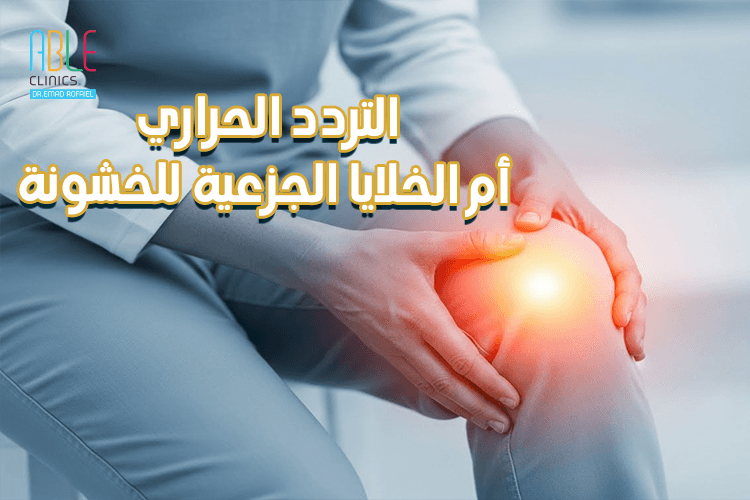
Joint replacement is no longer the only option for knee osteoarthritis patients. Thanks to recent advancements, a wide range of thermal frequency treatments and non-surgical therapies are now available to relieve pain, delay deterioration, and improve joint function. Here, we present a comparison of the most prominent techniques currently available.
What is Thermal Frequency Treatment?
It is a simple, minimally invasive procedure that utilizes an advanced technique for long-term pain relief by controlling nerve signals. Thermal frequency treatment works by using electrical currents to generate heat that disrupts the sensory nerves responsible for transmitting pain signals from the knee joint.
Advantages and Disadvantages of Thermal Frequency Treatment
Goal: The goal of thermal frequency treatment is to relieve pain (nerve pathway), while stem cell therapy aims at regeneration and repair (biological pathway).
Advantages: It is highly effective at rapidly reducing pain (within days), has a short recovery time, and is suitable for advanced stages that cannot be repaired. Stem cells, on the other hand, have the advantage of being able to repair damage and slow disease progression in the long term.
Disadvantages: Thermal frequency treatment does not address the underlying cause of osteoarthritis (cartilage wear), and its effects are temporary (usually 6-18 months). Stem cell therapy takes longer to show results, is more expensive, and may not be effective in severe cartilage loss.
What are Stem Cells?
Stem cells are undifferentiated cells with the unique ability to regenerate and transform into various types of cells depending on the body's needs, such as cartilage, bone, or muscle cells. These cells are essential in the body's natural repair processes, acting as a biological reservoir to replace damaged cells and rebuild affected tissues.
Advantages and Disadvantages of Stem Cell Therapy
Goal: Stem cell therapy aims to repair and regenerate the joint, not just relieve pain. When stem cells are injected into the knee joint, they help regenerate damaged tissues.
Advantages:
Repairs damaged tissues, not just pain relief.
Reduces chronic inflammation inside the joint naturally.
Long-term results compared to traditional injections.
Helps improve movement and function, reducing the need for surgery.
Disadvantages:
Takes longer to show results compared to thermal frequency treatment.
Effectiveness decreases in very advanced stages (Grade 4) due to complete cartilage loss.
More expensive due to the need for advanced laboratory and preparation techniques.
May require combination with other treatments for optimal results.
Difference Between Thermal Frequency and Stem Cells
If the goal is rapid and lasting pain relief, especially in advanced stages or after surgeries, thermal frequency treatment is the best option as it directly addresses the sensation of pain. However, if the goal is to improve the condition of the joint and slow the progression of osteoarthritis through a true biological mechanism, stem cells offer the stronger option, especially in moderate stages of osteoarthritis.
First: Injection-Based Treatments and Biological Regeneration
These injections form the core of non-surgical treatments, ranging from mechanical lubrication to biological tissue regeneration.
A. Stem Cell Injections (Stem Cell Therapy): The Pinnacle of Biological Regeneration
How it works in detail: Mesenchymal stem cells (MSCs) are harvested from an autologous source (usually fat or bone marrow) under local anesthesia, then concentrated and injected directly into the joint. These cells act as small factories, releasing powerful anti-inflammatory molecules and growth factors. They help slow cartilage wear and regenerate damaged cells by differentiating into various cell types, including cartilage cells (Chondrocytes). This contributes to creating a healthier joint environment.
Optimal role: Best for moderate stages (Grade 2-3) where there is remaining cartilage that can be stimulated for repair.
Effectiveness: Results appear gradually over several weeks, with the aim of providing long-term relief and slowing the disease's progression.
B. Platelet-Rich Plasma (PRP) Injections
How it works in detail: A blood sample is drawn from the patient, then processed in a centrifuge to concentrate the platelets. These platelets are rich in growth factors (such as PDGF, TGF-$\beta$) that, when injected into the joint, stimulate tissue healing, reduce inflammation, and improve the joint environment by activating local cells. Since it’s autologous material, it’s safe for the patient.
Optimal role: Excellent treatment for mild to moderate stages, and effective for treating tendon and ligament injuries around the knee.
Effectiveness: Typically requires 2-3 sessions spaced apart, and the effects last from 6 months to a year.
C. Hyaluronic Acid (HA) Injections
How it works in detail: Known as "viscosupplementation," hyaluronic acid is the main component of synovial fluid (the lubricant of the joint). It enhances the viscosity of the joint fluid, increases its elasticity, and reduces mechanical friction between joint bones. It also has mild anti-inflammatory effects. The procedure may require a single injection or a series of weekly injections.
Optimal role: An excellent mechanical symptomatic treatment for mild to moderate stages, but lacks the regenerative power of PRP or stem cells.
Effectiveness: Focuses on improving movement and reducing pain from friction, and its effects typically last from 6 to 12 months.
Second: Thermal Frequency Treatment (RFA): Advanced Nerve Pain Relief
While the treatments above focus on the joint itself, thermal frequency treatment stands out as a technique that targets immediate and direct pain relief, making it the ideal solution for chronic pain.
Primary goal: Pain relief and providing long-term comfort (6-18 months), not addressing structural damage.
How it works: This technique uses a specialized needle, guided under imaging, to target sensory nerves in the knee. Radio waves generate precise heat (85°C) to safely disrupt these nerves without affecting joint movement.
Cooled Thermal Frequency: This modern technique ensures that a larger, more comprehensive area of nerves is disrupted, increasing the success rate of thermal frequency treatment and prolonging the relief duration.
Role in advanced stages: The strongest option for advanced stages (Grade 4) and for patients with persistent pain after joint replacement surgery or those with medical contraindications for surgery.
Third: Other Non-Surgical Treatment Methods
An effective treatment plan includes other essential elements:
Physical Therapy and Rehabilitation: Strengthening the muscles around the knee (especially the quadriceps) to reduce strain on the affected joint. This is a fundamental treatment that should be combined with all other techniques.
Weight Management: Losing even a few kilograms is crucial, as each kilogram reduces the pressure on the knee by three times.
Medications and Pain Relievers: Using NSAIDs or topical pain relievers to reduce inflammation and provide temporary pain relief.
Corticosteroid Injections: A quick procedure aimed at reducing inflammation and swelling in the joint. Corticosteroids are potent anti-inflammatories, providing rapid relief from pain. However, they should not be repeated excessively (usually no more than 3-4 times per year) to avoid potential negative effects on cartilage over the long term.
Conclusion:
If the goal is rapid and powerful long-term pain relief (6 months or more), especially in advanced stages, thermal frequency treatment is the best choice.
If the goal is tissue regeneration and slowing the disease, stem cells are the stronger option, followed by PRP.
A precise medical evaluation of the degree of osteoarthritis and pain pattern is the first step in determining the best combination of these treatments. The decision should be made based on the degree of osteoarthritis and medical consultation, which is key to determining the optimal treatment path.